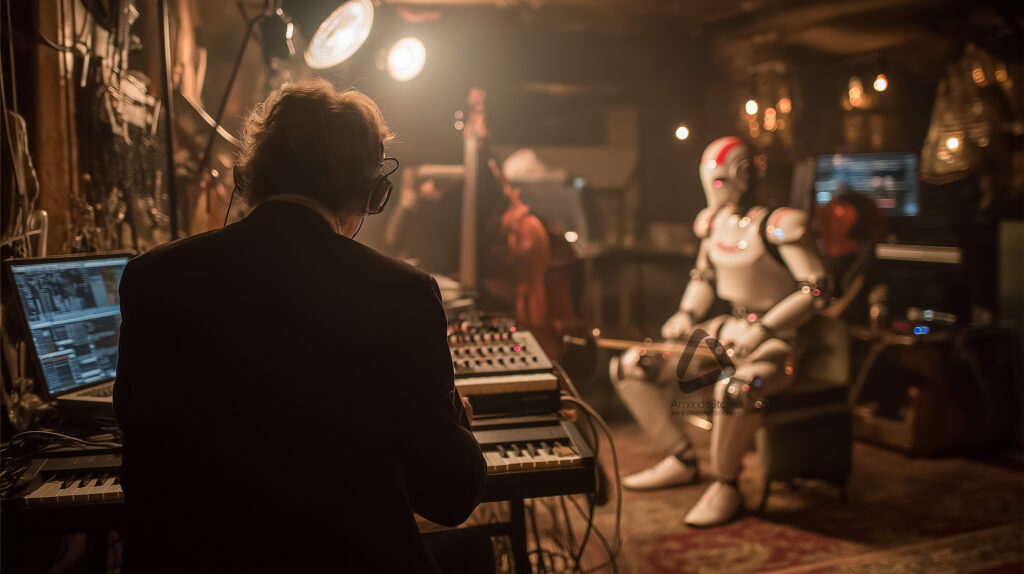
Remember when your favorite artist would disappear for two years to work on an album, and we’d all lose our minds when it finally dropped? Yeah, that might become a quaint memory. According to Pete Johns’ fascinating piece “Music in 2050: The Next 25 Years,” we’re heading toward a future where AI doesn’t just help make music—it might actually be running the show.
Your Personal DJ That Never Sleeps
Here’s something wild to think about: by 2050, AI could be churning out hundreds of songs every single day, each one perfectly tailored to what you’re feeling right now. Not just “songs you might like” based on what you listened to last week, but music that adapts to your actual heart rate and mood in real time. It’s like having a composer living inside your headphones who knows exactly what you need to hear.
The cool part? No two people would ever hear quite the same thing. Your morning commute playlist would be uniquely yours in a way that’s hard to imagine today. But here’s where it gets a bit weird—this could mean the end of those moments when everyone’s talking about the same hot new track. Remember when we all collectively lost it over certain songs? That shared cultural moment might fade away.
Hologram Concerts and Robot Rock Stars
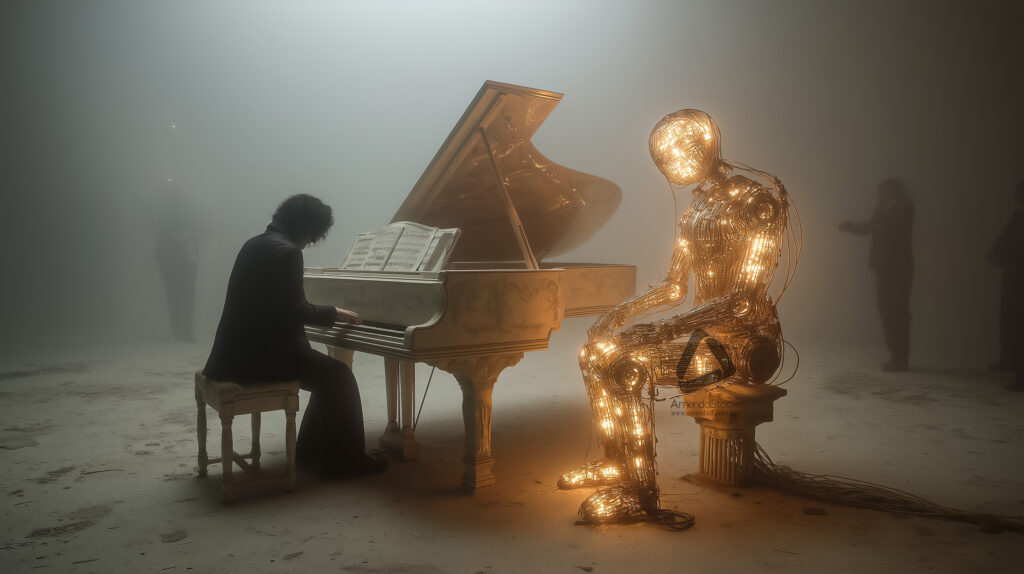
If you think AI making music is strange, wait until you hear about the performers. We’re talking about holographic concerts happening simultaneously in 50 different countries, with virtual artists that don’t need tour buses or hotel rooms. Imagine putting on VR goggles and finding yourself front row at a concert with people from around the world, all experiencing the same show but from their living rooms.
It sounds like science fiction, but we’re already seeing early versions of this. The technology is racing ahead, and by 2050, the line between “real” and “virtual” performances might be so blurred that we stop caring about the difference.

The Heart vs. The Algorithm
This is where things get emotional. Music has always been about human expression—the raw, messy, imperfect beauty of someone pouring their soul into a song. But AI doesn’t have soul (at least not yet). It has data, algorithms, and patterns. It can analyze what makes a song catchy, but can it capture the feeling of heartbreak at 2 AM? Can it understand why a slightly off-key note sometimes hits harder than a perfect one?
Some people will argue that it doesn’t matter—good music is good music, regardless of who (or what) made it. Others will feel like we’re losing something essential, something deeply human. It’s a debate that’s only going to get louder as AI gets better at mimicking human creativity.
Show Me the Money (and Who Gets It)
Let’s talk about the business side for a second. Right now, artists make money through streaming, concerts, and merchandise. But when AI can generate unlimited music, what happens to that model? Johns suggests we might see a future where there are different tiers—premium subscriptions for “human-made” music and cheaper options for AI-generated tracks.
The blockchain and smart contracts could make royalty payments instant and transparent, which sounds great. But there’s a darker possibility: human musicians getting pushed to the margins while AI-generated muzak dominates simply because it’s cheaper and easier to produce. It’s the artistic equivalent of fast fashion versus haute couture.

Who Owns a Song Written by a Robot?
This is the question that’s going to keep lawyers busy for decades. If an AI creates a hit song after being trained on thousands of existing tracks, who owns it? The company that made the AI? The people whose music was used to train it? The person who typed in the prompt? We don’t have good answers yet, and the legal system is scrambling to catch up.
Finding the Balance
Look, I’m not trying to paint this as all doom and gloom. There’s something genuinely exciting about the possibilities here. Human musicians could use AI as a powerful creative partner, exploring sounds and compositions they’d never think of on their own. Small artists might gain access to production tools that once required expensive studios. Global collaboration could become effortless.
But we also need to be thoughtful about what we’re willing to give up. Music isn’t just entertainment—it’s how we connect with each other, how we mark the important moments in our lives, how we express things words can’t capture. If we let algorithms completely take over, we might gain efficiency but lose something irreplaceable.

The Big Question
As we head toward 2050, we’re going to have to make some choices about what we value. Do we want endless personalized content, or shared cultural experiences? Algorithmic perfection, or human imperfection? Convenience, or authenticity?
Maybe the answer isn’t either/or. Maybe the future of music is finding the sweet spot where human creativity and AI innovation work together rather than compete. Where technology amplifies what makes us human instead of replacing it.
One thing’s for sure—the music of tomorrow is going to sound different than anything we’ve heard before. Whether that’s thrilling or terrifying probably depends on how we handle the transition. The beat is changing, and we’re all learning the new rhythm together.