
Picture this: it’s future of education 2050, and your daughter isn’t sitting in a classroom with thirty other kids, staring at a whiteboard. Instead, she’s on the couch with VR goggles, walking through ancient Rome with a student from Tokyo, while an AI tutor gently nudges her toward concepts she’s ready to master. Sound like science fiction? Maybe. But it’s the direction we’re heading.

Goodbye, Traditional Classrooms
Let’s be honest—the classroom model we’ve used for over a century is showing its age. Those rows of desks, the bells ringing every forty-five minutes, the same lesson delivered to everyone regardless of whether they’re bored or lost—it’s not working for a lot of kids.
By 2050, this setup will likely feel as outdated as a rotary phone. Learning will happen everywhere: at home, in community spaces, even while traveling. Students will learn when they’re most alert and engaged, not because the school schedule says it’s time for math. For kids in remote areas, those with disabilities, or anyone who doesn’t fit the traditional mold, this shift could be life-changing.

AI That Actually Gets You
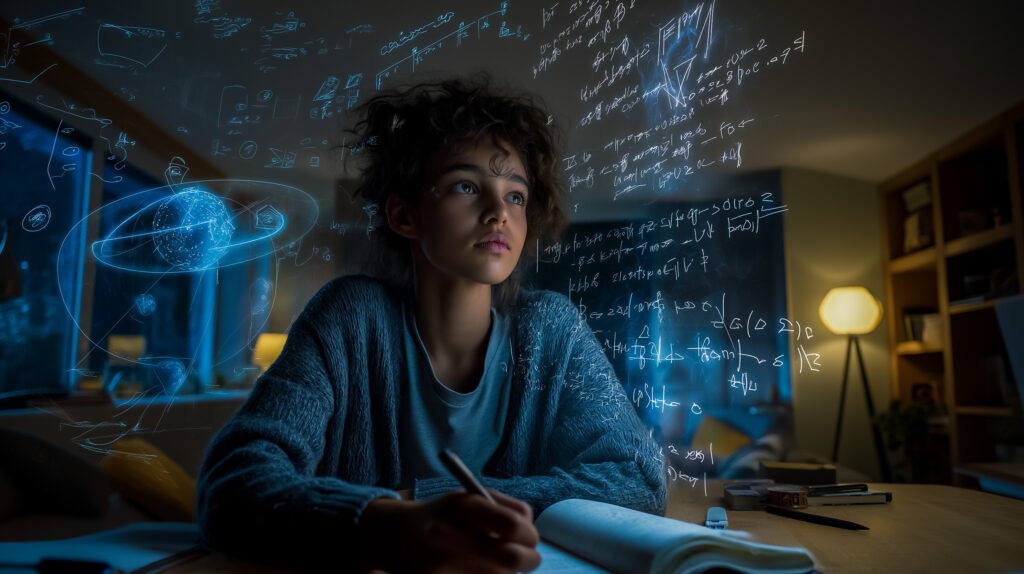
Here’s where things get interesting. Imagine having a tutor who knows exactly where you’re struggling, never gets tired, and can explain calculus seventeen different ways until one finally clicks. That’s what AI-powered learning could offer.
These systems won’t just assign homework—they’ll understand your learning style, your interests, and your goals. Struggling with biology but obsessed with video games? Your AI tutor might teach cellular processes through game design. It’s education that bends to fit you, not the other way around.
Students won’t be locked into rigid curriculums anymore. Instead, they’ll follow their curiosity, jumping between subjects that connect in ways that make sense to them. A project on climate change might weave together science, politics, economics, and ethics—because real-world problems don’t come neatly divided into class periods.

Learning You Can Touch and Feel
Remember those field trips to museums or science centers? Now imagine that, but you can go anywhere, anytime. With virtual and augmented reality, a history lesson could mean actually walking through a Viking village or watching the signing of the Declaration of Independence. Biology class could involve shrinking down to explore inside a living cell.
It’s not just flashy tech for the sake of it—there’s real value in experiencing things rather than just reading about them. When you can manipulate a 3D model of the human heart, rotating it, zooming in, seeing how blood flows through each chamber, it sticks with you in a way a diagram never could.
And those field trips? They won’t be limited by budget cuts or permission slips. A class could explore the Great Barrier Reef in the morning and tour the International Space Station after lunch, all without leaving their learning space.

Tech That Reads Your Mind (Sort of)
This part might sound a bit Black Mirror, but brain-computer interfaces and wearable tech are already here in early forms. By 2050, they could be commonplace in education.
Imagine devices that can sense when you’re getting frustrated or losing focus, and automatically adjust the lesson or suggest a break. For students with physical disabilities, being able to interact with computers using just your thoughts could be revolutionary. Your smartwatch might track not just your steps, but your stress levels during a test, helping teachers understand what’s really challenging for students.
Of course, this raises big questions about privacy and data—questions we’ll need to answer carefully. But the potential to help students learn more effectively is huge.
A Classroom Without Borders
One silver lining from the pandemic was discovering that students across the world could collaborate in ways we never tried before. By 2050, this will be the norm, not the exception.
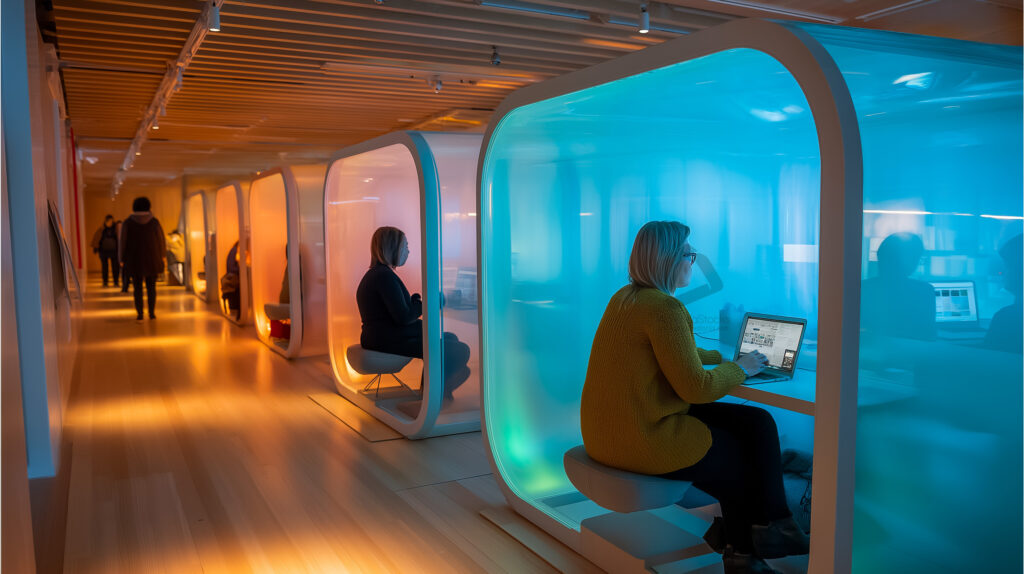
Your study group might include someone from Brazil, Nigeria, and India. You might take a literature course taught by a professor at Oxford, a coding class from a Silicon Valley expert, and a philosophy seminar from a local teacher you love—all woven together into your personalized education.
This isn’t about replacing local schools or teachers. It’s about expanding what’s possible. The best educators will reach more students, and students will be exposed to perspectives and ideas from across the globe. In a world that’s increasingly connected, this kind of global literacy will be essential.

Learning That Never Stops
Here’s a reality check: the career you train for at twenty probably won’t exist by the time you’re forty, at least not in the same form. The pace of change is accelerating, which means learning can’t stop at graduation.
By 2050, education will be something you do throughout your life, not just in your youth. When your industry shifts or you want to change careers, you’ll dive back into learning—taking courses, earning certifications, picking up new skills. The distinction between “student” and “professional” will blur.
This might sound exhausting, but it’s also empowering. You won’t be locked into choices you made at eighteen. Learning will be more like a journey you’re always on, adapting and growing as the world changes around you.

The Human Element Still Matters
With all this technology, it’s easy to worry we’ll lose something essential. And honestly? That’s a real concern. Kids still need to play together, argue about ideas, collaborate on messy projects, and form real relationships. They need teachers who care about them, not just their test scores.
The schools that thrive in 2050 will be the ones that use technology to enhance human connection, not replace it. They’ll balance screen time with face-to-face interaction. They’ll remember that education isn’t just about downloading information—it’s about becoming a thoughtful, creative, connected human being.
There are legitimate worries too: What about privacy? Screen addiction? Kids who fall through the cracks of automated systems? Economic inequality in access to technology? These aren’t small concerns, and we’ll need to address them head-on.
What It All Means
By 2050, education could be more flexible, more personalized, and more accessible than ever before. A student in rural Kenya could access the same quality instruction as one in Manhattan. A kid who’s always struggled in traditional classrooms might finally thrive with an approach that fits how their brain works.
But technology is just a tool. What matters is what we do with it. Will we use these innovations to create a more equitable, engaging, enriching educational experience for everyone? Or will we deepen existing divides?
The future of education isn’t set in stone—it’s something we’re creating right now with every decision we make. And if we get it right, we might just build a system that brings out the best in every learner, preparing them not just for jobs, but for lives full of curiosity, growth, and possibility.
That’s a future worth working toward.



Pingback: why kids love animals